
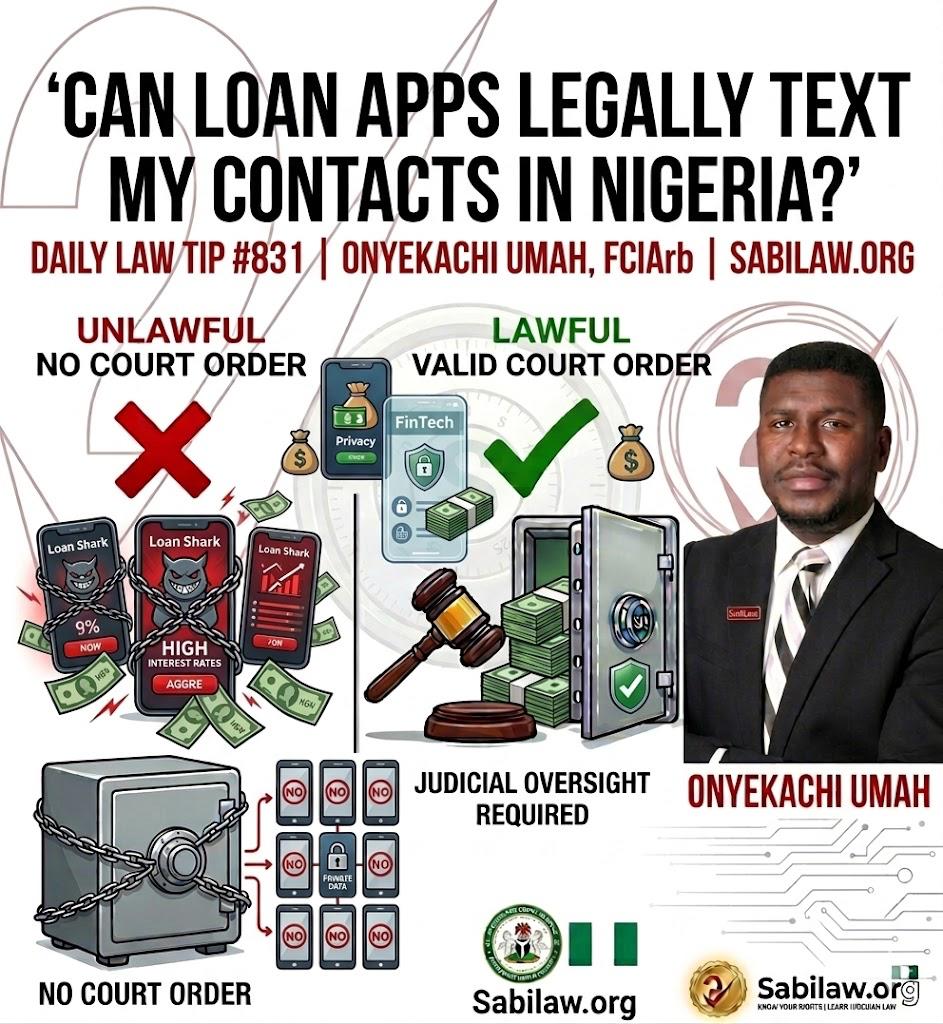
Can Loan Apps Send Messages to My Contacts in Nigeria?
Daily Law Tips (Tip 831)
Onyekachi Umah, Esq., LL.M, MBA, FCIArb (UK)
- Introduction
One of the most persistent, stressful, and embarrassing challenges faced by digital borrowers in Nigeria is the threat of public shaming. Many predatory, unlicensed digital money lenders (often called “loan sharks”) routinely download a borrower’s entire phone book and broadcast defamatory messages to their family, friends, and employers to force repayment. It was embarrassing to receive a message from an unpopular loan app saying that my classmate, who was to celebrate the son’s child dedication the following Sunday, owed Fifty Thousand Naira (N50,000.00). I got a similar message regarding a client of mine who owed our law office some legal fees. The list is endless.
If you are wondering whether loan apps or even any apps/platform/persons have any legal right to contact the people in your phonebook, the answer is a definitive NO. Doing so is a severe violation of your human rights, and the Nigerian consumer protection laws and data privacy regulations.
- What the Nigerian Constitution Says About Apps Contacting Your Contacts
The starting point is the Constitution of the Federal Republic of Nigeria 1999. The greatest of all laws, regulations and policies in the world, as far as a Nigerian citizen, or any person in Nigeria, is concerned, on anything/issue, is the Constitution of the Federal Republic of Nigeria 1999. So, what does it say about this issue?
Section 37 of the Constitution guarantees and protects the privacy of citizens, their homes, correspondence, telephone conversations, and telegraphic communications. The right to privacy is a fundamental right and forms part of the constitutional safeguards available to every person in Nigeria. Section 37 reads thus; “The privacy of citizens, their homes, correspondence, telephone conversations and telegraphic communications is hereby guaranteed and protected.”
I like the way the Court of Appeal explain “the right to privacy” in the case of INCORPORATED TRUSTEES OF DIGITAL RIGHTS LAWYERS INITIATIVE & ORS v. NATIONAL IDENTITY MANAGEMENT COMMISSION (2021) LPELR-55623(CA), where the court held that:
“In declining jurisdiction to entertain the Appellants’ Originating Summons, the trial Court had, at pages 89 -90 of the Record of Appeal, considered the decisions of this Court inFRN v. DANIEL (2011) LPELR-4152(CA) and NWALI v. EBSIEC (2014) LPELR-23614(CA), on which the Appellant relied, and held as follows: These two decided cases clearly explain the scope and ramifications of the right guaranteed under Section 37 of the Constitution. The kernel of both the provision of Section 37 of the Constitution and these illuminating decisions is to my mind, that privacy of a citizen of Nigeria shall not be violated. From these decisions, privacy to my mind can be said to mean the right to be free from public attention or the right not to have others intrude into one’s private space uninvited or without one’s approval. It means to be able to stay away or apart from others without observation or intrusion. It also includes the protection of personal information from others. This right to privacy is not limited to his home but extends to anything that is private and personal to him including communication and personal data.”
3. A Note on the Scope of Section 37 of the Constitution
Hence, no person, including loan app, law enforcement agencies, your spouse, family and friends should access your phone, emails, letters, messages, chats, social media accounts, and even homes without your permission or an order of court. If any person threatens to or attempts to violate this right, you should immediately contact your lawyer to seek justice in the courts or at the National Human Rights Commission. Details of how to seek justice are discussed below.
The right to private and family life is a fundamental right and constitutional right available to citizens of Nigeria. I must point out that the Constitution did not say every person in Nigeria; rather, it says “citizens”. By virtue of sections 25 to 31 and 309 of the Constitution of the Federal Republic of Nigeria 1999, the “citizens” mentioned in the Constitution are the Citizens of Nigeria only. Hence, this constitutional protection is arguably enjoyed only by Nigerian citizens. Non-citizens of Nigeria, even when in Nigeria, may not enjoy the right to private and family life enshrined (contained) in section 37 of the Constitution of the Federal Republic of Nigeria 1999 (the Constitution). Section 37 of the Constitution is not the only section that expressly limits certain fundamental rights to citizens of Nigeria; the list includes sections 41 (right to freedom of movement), 42 (right to freedom from discrimination), and section 43 (Right to acquire and own immovable property). Arguably, non-Nigerians cannot approach any court in Nigeria to enforce any of the above fundamental rights under our Constitution. It also seems that corporate beings (companies and associations) as well as statutory bodies (government agencies and corporations), though they are persons (juristic persons), they are not citizens and as such cannot enjoy section 37 of the Constitution. I more convinced in the light of the decision in INCORPORATED TRUSTEES OF DIGITAL RIGHTS LAWYERS INITIATIVE & ORS v. NATIONAL IDENTITY MANAGEMENT COMMISSION (2021) LPELR-55623(CA), where the court held that:
“In highlighting the absence of a clear scope of the right to “privacy of citizens” as guaranteed under Section 37 of CFRN, 1999, this Court, per Agim, JCA (as he then was, now JSC), had held in the cited case of NWALI v. EBSIEC (2014) LPELR-23682(CA) at pages 27 – 29, para. E, as follows: The meaning of the term “privacy of citizens” is not directly obvious on its face. It is obviously very wide as it does not define the specific aspects of the privacy of citizens it protects. A citizen is ordinarily a human being constitution of his body, his life, his person, thought, conscience, belief, decisions (including his plans and choices), desires, his health, his relationships, character, possessions, family, etc. So how should the term “privacy of citizens” be understood?
4. A Note on the Correct Citation of the Constitution
As part of my legal awareness campaigns, I must mention that you may have seen or see some people cite (mention) it as “Constitution of the Federal Republic of Nigeria 1999 (as amended)”. The right way to cite the Nigerian Constitution is contained in section 319 of the Constitution, and it simply says: “This Constitution may be cited as the Constitution of the Federal Republic of Nigeria 1999”. So, like a user manual, no one knows how to cite the Constitution more than the Constitution. I often wonder why we don’t add “as amended” when citing any of the other amended laws in Nigeria. And, even if you, those laws also clearly provide how they should be cited; it is a legislative role and not a judicial one. I am not aware any court amended section 319 of the Constitution of the Federal Republic of Nigeria 1999. My earlier work on “the Correct Citation of the Constitution of Nigeria” is accessible at [https://sabilaw.org/the-correct-citation-of-the-constitution-of-nigeria/]. Also, here is a link to the complete copy of the Constitution of the Federal Republic of Nigeria 1999 is accessible at [https://sabilaw.org/copy-of-the-constitution-of-the-federal-republic-of-nigeria-1999/].
- What Other Nigerian Laws Say About Apps Contacting Your Contacts
In Nigeria, aside from the Constitution, every person’s data and consumer rights are protected by robust legal frameworks, notably the Nigeria Data Protection Act (NDPA) and the Federal Competition and Consumer Protection Act (FCCP Act).
The federal law; Nigeria Data Protection Act (NDPA), in this context, mandates loan apps as data controllers or data processors to ensure that personal data are “processed in a fair, lawful and transparent manner” and also “collected for specified, explicit, and legitimate purposes, and not to be further processed in a way incompatible with these purposes”. I believe there is no loan app that will specify to borrowers that it will send messages to their family and friends for debt recovery, so most loan apps are in violation of Section 24(1)(a) and (b) of the Nigeria Data Protection Act when they broadcast messages to borrowers’ family and friends. Even if borrowers are informed that their debt status will be broadcasted to their family and friends, and the borrowers signed and accepted such terms, the Nigeria Data Protection Act (NDPA) renders that acceptance useless. Specifically, section 25(2)(a) of the Nigeria Data Protection Act (NDPA), prohibits such on the grounds that it cannot override the fundamental rights, freedoms and the interests of the borrowers. Every borrower has the right to demand and be informed about the purpose of the data to be collected, including details of the data retention plan, third-party access to it, means of requesting erasure of the data, source of the data, and use of automated decision-making processes on the data, among others, as provided in section 34(1)(a) of the Nigeria Data Protection Act (NDPA). When you install a loan app, you might click “Allow” to grant it access to your contacts to proceed with setting up the app. Legally, granting access to view data is not the same as granting permission to use that data to harass, defame, or intimidate third parties. The Nigeria Data Protection Act further regulates loan apps by issuing an Audit Trust mark and the Compliance Audit Report and Privacy Impact Assessment Report when a loan app registers with it as a Data Protection Compliance Organisation (DPCO).
The Federal Competition and Consumer Protection Act (FCCP Act) protects consumers, including borrowers, from “physical force, coercion, undue influence or pressure, harassment, unfair tactics or any other similar conduct” by loan apps; as contained in Section 124 of the FCCP Act. Furthermore, under the FCCPC’s Limited Interim Regulatory/Registration Framework and Guidelines for Digital Lending 2022 digital money lenders are strictly prohibited from harvesting or accessing consumers’ contacts or photos. The guidelines mandate that all lawful loan apps declare in writing that they will not harass borrowers or use unlawful means to recover debts. It reads thus; “We have complied with; and will continue to comply with all provisions of law with respect to third-party privacy rights and personal data including data unrelated to principles of lending as well as recovery practices that are consistent with fair lending principles and provided for under Sections 17(g), (y); 114; 124; 125; 127; and 129 of the Federal Competition and Consumer Protection Act, 2018; and the Nigeria Data Protection Regulations, 2019”.
The fact that a person owes a debt does not automatically entitle a lender to publicly shame, embarrass, harass, intimidate, or disclose the person’s financial obligations to third parties. Debt recovery efforts must be conducted lawfully and in a manner that respects the rights and dignity of individuals. Where a loan app sends messages to a borrower’s contacts alleging that the borrower is a debtor, a fraudster, a criminal, or uses any language capable of damaging the borrower’s reputation, legal issues relating to privacy, data protection, confidentiality, harassment, and even defamation may arise depending on the circumstances. Similarly, where third-party personal information in a borrower’s contact list is accessed, processed, or used without lawful justification, additional data protection concerns may arise. The rights of both the borrower and the persons whose information is disclosed should be respected.
It is important for borrowers to understand the permissions they grant to mobile applications and to carefully review privacy notices and user agreements before sharing personal information. At the same time, digital lenders must ensure that their debt recovery practices comply with applicable laws and regulatory requirements. A lender can send automated Short Message Service (SMS) or email reminders to your personal number, place phone calls to you, and apply agreed late fees. However, once they harvest your contacts and send messages to any third party (such as your boss, friends, or parents), they have crossed into illegal data breaches and consumer harassment. Persons who believe that their privacy rights have been violated or that their personal data has been unlawfully processed may seek legal advice and explore the remedies available under applicable laws and regulations.
- What to Do If a Loan App Messages Your Contacts
If a loan app is actively harassing your phonebook or threatening to do so, do not let panic make you a victim of extortion. Take these immediate legal steps:
- Preserve Your Evidence: Never delete the messages out of anger or shame. Take clear screenshots of the abusive text messages, WhatsApp chats, call logs, and the phone numbers used by the recovery agents. Ensure timestamps and numbers are fully visible. You may save them on your cloud or share them with another person, so that you don’t lose them if your phone is damaged.
- Engage a Lawyer: Lawyers are trained to listen to you and advise you on managing the situation and seeking justice.
- Report to the FCCPC: Have your lawyer lodge a complaint at the FCCPC via its Complaint Portal [https://complaints.fccpc.gov.ng/Home/login] with your compiled evidence, the exact name of the loan app, and their digital storefront link.
- Flag on the App Store: Go to the app listing on the Google Play Store or Apple App Store, click on the options menu, select “Flag as inappropriate,” and report it for malicious behaviour, privacy violations, and cyber-harassment.
- Seek Justice in Court, NHRC & Police: If an app circulates defamatory graphics, falsely labels you a criminal, or publishes your photos online, a lawyer can help you initiate cyber-extortion criminal complaints with the Police Cybercrime Unit and also file a lawsuit for substantial monetary damages or petition to he National Human Rights Commission (NHRC).
7. Conclusion
Owing a debt is a civil matter; it does not turn the borrower into a criminal, nor does it strip away the borrower’s constitutional right to human dignity. Always verify a digital lender’s status against the FCCPC’s approved list of digital money lenders before downloading any financial app.
The convenience of digital lending should not come at the expense of privacy, dignity, and respect for the rule of law. Technology may change the way loans are granted, but it does not eliminate the legal rights of borrowers and other individuals. Owing a debt does not automatically authorise a loan app to misuse personal information, invade privacy, or unlawfully disclose a person’s financial affairs to third parties.
Thank you.
Onyekachi Umah, FCIArb (UK)
Managing Partner, SabiLaw Firm
+234 803 766 5878

SabiLaw Firm
Legal, Arbitration and Notarial Services
+234 813 432 4743
References:
- Constitution of the Federal Republic of Nigeria 1999
- Nigeria Data Protection Act, 2023 (NDPA)
- Federal Competition and Consumer Protection Act, 2018 (FCCPA)
- FCCPC Limited Interim Regulatory/Registration Framework and Guidelines for Digital Lending, 2022
- Onyekachi Umah, “Legality of the “EFCC Order” on Bank Employees Declaration of Assets” (ThisDay, 6 April 2021) <https://www.thisdaylive.com/index.php/2021/04/06/legality-of-the-efcc-order-on-bank-employees-declaration-of-assets/amp/> accessed 7 April 2021.
- Onyekachi Umah, “The Minimum Financial Threshold for EFCC Cases.” (SabiLaw.org, 1 September 2020) <https://sabilaw.org/the-minimum-financial-threshold-for-efcc-cases/> accessed 16 July 2021
- Onyekachi Umah, “The Central Bank of Nigeria Notices on Cryptocurrencies; a Ban or a Banger?” (SabiLaw.org, 9 February 2021) <https://sabilaw.org/the-central-bank-of-nigeria-notices-on-cryptocurrencies-a-ban-or-a-banger/> accessed 17 February 2021
- Onyekachi Umah, “Unlawfulness of the EFCC Order on Bankers Declaration of Assets” (SabiLaw.org, 8 April 2021) <https://sabilaw.org/unlawfulness-of-the-efcc-order-on-bankers-declaration-of-assets/> accessed 12 April 2021
- Onyekachi Umah, “Debunking Myths Relating to Bankers Declaration of Assets Law” (SabiLaw.org, 12 April 2021) <https://sabilaw.org/debunking-myths-relating-to-bankers-declaration-of-assets-law/> accessed 20 April 2021
- Onyekachi Umah, “Nigerians That Are Prohibited From Having Foreign Bank Accounts” (SabiLaw.org, 25 November 2020) <https://sabilaw.org/nigerians-that-are-prohibited-from-having-foreign-bank-accounts/> accessed 16 July 2021
- Onyekachi Umah, “The Supreme Court Has Warned Efcc And Police Against Recovering Debts And Investigating Disputes From Civil Transactions.” (SabiLaw.org, 26 October 2019) <https://sabilaw.org/the-supreme-court-has-warned-efcc-and-police-against-recovering-debts-and-investigating-disputes-from-civil-transactions-daily-law-tips-tip-444-by-onyekachi-umah-esq-llm-aciarb-uk/> accessed 16 July 2021
- Onyekachi Umah, “Twitter vs. Nigeria; The Human Rights of Twitter Inc. and the Twitter Users” (SabiLaw.org, 8 June 2021) <https://sabilaw.org/twitter-vs-nigeria-the-human-rights-of-twitter-inc-and-the-twitter-users/> accessed 9 June 2021.
- Onyekachi Umah, “Scarcity of Passport and the Government’s Violation of the Right of Movement” (SabiLaw.org, 1 June 2021) <https://sabilaw.org/scarcity-of-passport-and-the-governments-violation-of-the-right-of-movement/> accessed 8 June 2021
- Onyekachi Umah, “An Alternative to Courts for Human Rights Cases” (SabiLaw.org, 14 May 2021) <https://sabilaw.org/an-alternative-to-courts-for-human-rights-cases/> accessed 23 May 2021.
- Onyekachi Umah, “Details of State Offices of National Human Rights Commission” (SabiLaw.org, 27 October 2020) <https://sabilaw.org/details-of-state-offices-of-national-human-rights-commission/> accessed 14 May 2021
- Onyekachi Umah, “Human Rights That Can Never Be Restricted Even In War, Pandemic or State of Emergency” (SabiLaw.org, 2 April 2020) <https://sabilaw.org/human-rights-that-can-never-be-restricted-even-in-war-pandemic-or-state-of-emergency-daily-law-tips-tip-539-by-onyekachi-umah-esq-llm-aciarbuk/> accessed 23 May 2021
SabiLaw Solutions:
👩🎓Take short certificate courses and training at SabiLaw Academy; www.Academy.SabiLaw.org
🛒 Download templates, samples, forms and precedents at SabiTemplates; Templates.SabiLaw.org
💻 Access Nigerian laws, court judgments, regulations, bye-laws and reports at SabiLaw; www.SabiLaw.org
👨⚖️ For Legal Services, Arbitration Services or Notary Public Services, at SabiLaw Firm; www.LawFirm.SabiLaw.org
🎯 Publish and publicise your legal articles and materials for FREE on SabiLaw by sending them to: [email protected]
💼 Partner for legal awareness and advocacy projects in your programs with SabiLaw Foundation: www.Foundation.SabiLaw.org
🎁 Receive our free Daily Law Tips & other publications via our WhatsApp group: Daily Law Tips Group 5 and Telegram Channel: SabiLawGroup
For Legal Consultancy/Engagements, Arbitration Services or Notary Public Services, contact SabiLaw Firm (formerly, Bezaleel Chambers International) at [email protected] or Call/WhatsApp: +234 813 432 4743.
For Individual/Corporate Training, Legal Templates, Daily Law Tips, Institutional Solutions, and Partnerships, contact SabiLaw at [email protected] or Call/WhatsApp: +234 9155194001.
For free publication of your articles and materials on SabiLaw, contact SabiLaw at [email protected] or Call/WhatsApp: +234 9155194001.
****************************************************************************
This work is published under the free legal awareness project of Sabi Law Foundation (www.SabiLaw.org) funded by SabiLaw Firm (formerly, Bezaleel Chambers International) (www.LawFirm.SabiLaw.org). The writer was not paid or charged any publishing fee. You too can support the legal awareness projects and programs of Sabi Law Foundation by donating to us. Donate here and get our unique appreciation certificate or memento.
DISCLAIMER:
This publication is not a piece of legal advice. The opinion expressed in this publication is that of the author(s) and not necessarily the opinion of our organisation, staff and partners.
SOLUTIONS:
👩🎓Take short certificate courses and training at SabiLaw Academy; www.Academy.SabiLaw.org
🛒 Download templates, samples, forms and precedents at SabiTemplates; Templates.SabiLaw.org
💻 Access Nigerian laws, court judgments, regulations, bye-laws and reports at SabiLaw; www.SabiLaw.org
👨⚖️ For Legal Services, Arbitration Services or Notary Public Services, at SabiLaw Firm; www.LawFirm.SabiLaw.org
🎯 Publish and publicise your legal articles and materials for FREE on SabiLaw by sending them to: [email protected]
💼 Partner for legal awareness and advocacy projects in your programs with SabiLaw Foundation: www.Foundation.SabiLaw.org
🎁 Receive our free Daily Law Tips & other publications via our WhatsApp group: Daily Law Tips Group 5 and Telegram Channel: SabiLawGroup
KEEP IN TOUCH:
Get updates on all the free legal awareness projects of Sabi Law (#SabiLaw) and its partners, via:
YouTube: SabiLaw
X(Twitter): @Sabi_Law
Facebook page: SabiLaw
Instagram: @SabiLaw.org_
WhatsApp Group: Free Daily Law Tips Group 5
Telegram Channel: SabiLawGroup
Facebook group: SabiLaw
Email: [email protected]
Website: www.SabiLaw.org
ABOUT US & OUR PARTNERS:
This publication is the initiative of the Sabi Law Foundation (www.Foundation.SabiLaw.org) funded by the SabiLaw Firm (formerly, Bezaleel Chambers International) (www.LawFirm.SabiLaw.org). Sabi Law Foundation is a Not-For-Profit and Non-Governmental Legal Awareness and Advocacy Organization based in Nigeria. It is the first of its kind and has been promoting free legal awareness since 2010.
DONATION & SPONSORSHIP:
As a registered not-for-profit and non-governmental organisation, Sabi Law Foundation relies on donations and sponsorships to promote free legal awareness across Nigeria and the world. With a vast following across the globe, your donations will help us increase legal awareness, improve access to justice, and prevent and reduce common legal disputes and crimes in Nigeria. Make your donations to us HERE or contact us for sponsorship and partnership, via: [email protected] or +234 9155194001.
*****************************************************************************