
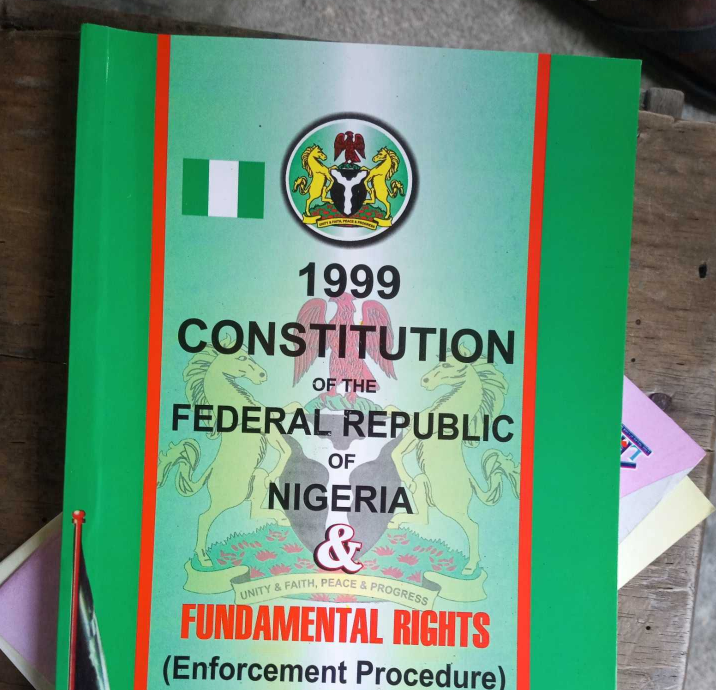
The 1999 Constitution: A Constitution for the People or A Document of Political Convenience?
By Gideon Joseph
Abstract
The legitimacy of a constitution is not determined exclusively by its formal legal authority but also by the circumstances surrounding its creation and the extent to which it reflects the collective aspirations of the people it governs. Nigeria’s 1999 Constitution presents an important subject for constitutional examination in this regard. Although it remains the supreme law of the Federal Republic of Nigeria, its emergence through a military promulgation raises fundamental questions concerning popular sovereignty, democratic participation and constitutional ownership. This article examines the historical circumstances surrounding the introduction of the Constitution, particularly the relationship between its declaration of popular ownership and the military process through which it acquired legal force. It further distinguishes constitutional validity from democratic legitimacy, arguing that the continued operation of a constitutional framework does not necessarily resolve questions concerning the democratic character of its origins. The article also considers the arguments in favour of constitutional continuity, the significance of constitutional amendment and the responsibility of the Nigerian people in shaping their constitutional future. It argues that while the 1999 Constitution has provided an important legal foundation for Nigeria’s democratic institutions, its historical origins and continuing institutional limitations justify sustained constitutional reflection. Ultimately, the article advocates a more inclusive and participatory approach to constitutional development, one that seeks to strengthen the relationship between constitutional authority and the people in whose name it operates.
Keywords: 1999 Constitution, Constitutional Legitimacy, Popular Sovereignty, Constitutionalism, Democratic Governance, Constitutional Reform, Nigeria.
- Introduction
A constitution is more than a collection of legal provisions regulating the exercise of governmental authority. It represents the fundamental framework upon which a political community organises itself, distributes public power, defines the relationship between the state and its citizens, and establishes the principles that guide governance. Ideally, it should embody the collective aspirations of the people, reflect their political identity and establish a system of government founded upon their consent.
In democratic societies, the legitimacy of a constitution is closely connected to the question of its origin. Although constitutional legitimacy may also develop through public acceptance, institutional continuity and the consistent operation of constitutional institutions, the process through which a constitution emerges remains an important consideration. A constitution that claims to derive its authority from the people must necessarily invite examination of the extent to which the people participated in its creation.
This question is particularly relevant to Nigeria’s 1999 Constitution. Since its commencement on 29 May 1999, the Constitution has provided the legal foundation for the country’s Fourth Republic and has remained the supreme law governing the Nigerian state. It establishes the institutions of government, defines their respective powers and provides mechanisms for the protection of fundamental rights.
Yet, beneath its formal legal authority lies a persistent constitutional question: to what extent can a constitution genuinely be regarded as the product of the people’s collective will when its immediate legal foundation was a military promulgation?
The question is not whether Nigeria requires a constitution. Neither is it an argument against the constitutional framework that has sustained the country’s democratic institutions since 1999. Rather, it concerns the relationship between constitutional authority, popular sovereignty and democratic legitimacy.
The central argument of this article is that the legal validity of the 1999 Constitution should not be confused with the democratic legitimacy of the process through which it emerged. Both questions deserve independent consideration. A constitution may function as the supreme law of a country while its historical origins continue to raise legitimate questions about the extent of popular participation and consent.
Understanding this distinction is essential to any meaningful discussion about constitutional reform in Nigeria.
- The Historical Circumstances Surrounding the 1999 Constitution
To understand the legitimacy question, it is necessary to examine the political circumstances surrounding the emergence of the present constitutional framework.
Nigeria’s return to democratic government in 1999 followed an extended period of military rule. Following the political instability that characterised the country from 1983, successive military administrations exercised governmental authority through decrees, military institutions and administrative structures that substantially displaced ordinary democratic processes.
The transition to civilian government accelerated following the death of General Sani Abacha in June 1998. His successor, General Abdulsalami Abubakar, introduced a transition programme intended to return the country to democratic governance.
As part of this process, the Federal Military Government established the Constitutional Debate Coordinating Committee in November 1998. The committee was assigned responsibilities relating to constitutional debate, the collation of public views and recommendations, and the preparation of a constitutional framework for the incoming civilian administration.
These developments are important because they demonstrate that the emergence of the 1999 Constitution was not entirely disconnected from public consultation. Individuals and groups were afforded opportunities to express their views concerning the country’s constitutional future. However, public consultation and the exercise of constituent authority are not necessarily the same thing.
Consultation allows individuals and groups to communicate their preferences to those responsible for making decisions. Constituent authority, on the other hand, concerns the fundamental power to establish or adopt the constitutional framework under which a political community is governed.
The distinction becomes particularly significant when the final constitutional instrument is legally brought into existence through the authority of a military government rather than through a constituent process in which the people exercise an identifiable and decisive role.
On 5 May 1999, the Federal Military Government promulgated the Constitution of the Federal Republic of Nigeria (Promulgation) Decree No 24 of 1999. The Constitution subsequently came into force on 29 May 1999, coinciding with the transfer of governmental authority to the elected civilian administration.
The historical significance of this process cannot be ignored. Nigeria’s return to civilian government was undoubtedly an important democratic development. Nevertheless, the question of whether the constitutional framework accompanying that transition possessed the same democratic foundation as a constitution directly adopted by the people remains open to serious examination.
The issue, therefore, is not simply that the Constitution emerged during a military administration. It is that the final legal authority through which it was introduced rested upon a military decree. This distinction provides the foundation for the broader debate about constitutional legitimacy.
- Popular Sovereignty and the Question of Constitutional Ownership
One of the most significant principles of modern constitutional democracy is popular sovereignty. Popular sovereignty recognises that ultimate political authority belongs to the people. Government exists to exercise public power on their behalf, and its authority must ultimately be connected to their collective political will. The principle is reflected in the opening words of the Preamble to the Nigerian Constitution: “We the people of the Federal Republic of Nigeria…”
The Preamble proceeds to declare that the people have resolved to live in unity and harmony and that they hereby make, enact and give to themselves the Constitution.
This language is not insignificant. It establishes a constitutional identity in which the people are presented as the ultimate source of the constitutional order. However, it also raises an important question: what does it mean for the people to declare that they have given themselves a constitution?
Is the statement merely a constitutional expression of national identity, or does it represent a claim about the historical process through which the Constitution was created?
If the Preamble is understood as an expression of popular sovereignty, it becomes necessary to examine whether the process of constitution-making adequately reflected that principle.
A constitutional declaration of popular ownership and the actual exercise of popular constituent authority are two related but distinct matters.
The presence of the words “We the people” does not, by itself, establish the extent to which the people exercised meaningful control over the constitutional process.
This does not mean that the Preamble has no constitutional significance. On the contrary, it expresses the foundational aspirations upon which the Nigerian constitutional order is supposed to rest. Nevertheless, constitutional language should not prevent critical examination of constitutional history.
Where a constitution declares the people to be its source, there is a legitimate basis for asking whether the process through which it emerged sufficiently reflected their participation, consent and collective aspirations. This is particularly important in a country as diverse as Nigeria, where constitutional arrangements have significant implications for federalism, political representation, resource distribution, identity and national cohesion.
A constitution intended to govern such a diverse political community should ideally command more than formal obedience. It should also enjoy a reasonable degree of public confidence and acceptance.
The question of constitutional ownership is therefore not an abstract academic exercise. It concerns the relationship between the Nigerian people and the fundamental legal framework under which they are governed.
- The Preamble and the Contradiction Between Constitutional Claim and Historical Process
The Preamble of the 1999 Constitution presents an interesting constitutional dilemma.
On the one hand, it declares that the people have resolved to establish a constitutional order founded upon unity, freedom, equality, justice and national welfare. On the other hand, the historical process through which the Constitution acquired legal force was characterised by military authority. This creates a tension between the language of popular constitutional ownership and the historical circumstances of constitutional promulgation.
It is important, however, not to oversimplify this issue. The fact that a constitution is introduced through a particular legal instrument does not automatically mean that it cannot subsequently acquire democratic legitimacy. Constitutional legitimacy may develop over time through public acceptance, democratic participation, institutional stability and the willingness of successive generations to operate within the constitutional framework.
Indeed, the 1999 Constitution has governed Nigeria through several successive civilian administrations. Elections have been conducted under its provisions, political institutions have operated within its framework, and constitutional disputes have regularly been resolved through the courts. These developments contribute to its continuing practical and institutional acceptance. Nevertheless, the existence of democratic continuity does not necessarily resolve every question concerning the legitimacy of its original creation.
A constitution may acquire practical acceptance without its historical origins becoming irrelevant. The distinction is important because constitutional legitimacy should not be treated as a single event or a permanent condition that can never be reconsidered. It is also sustained by the relationship between constitutional institutions and the people they are intended to serve.
The challenge, therefore, is to reconcile the constitutional promise of popular sovereignty with the historical circumstances surrounding the Constitution’s emergence.
Such reconciliation requires honest constitutional reflection rather than the assumption that the mere passage of time has settled every question.
- Legal Validity and Democratic Legitimacy: Two Different Questions
Perhaps the most important distinction in the debate surrounding the 1999 Constitution is the difference between legal validity and democratic legitimacy. Legal validity concerns whether a law derives its authority from a recognised legal source and operates within the applicable legal system.
Democratic legitimacy concerns whether the exercise of public authority, including the establishment of the constitutional framework, can reasonably be justified by reference to popular participation, consent and democratic principles.
The two concepts are related, but they are not identical.
Section 1(1) of the 1999 Constitution establishes the supremacy of the Constitution and provides that its provisions have binding force on all authorities and persons throughout Nigeria.
Section 1(2) further provides that Nigeria shall not be governed, nor shall any person or group take control of its government except in accordance with the provisions of the Constitution.
Section 1(3) establishes the consequence of inconsistency between the Constitution and another law: the Constitution prevails, and the inconsistent law is void to the extent of the inconsistency.
These provisions establish the Constitution’s position within the Nigerian legal system. They do not, however, eliminate the academic and political question concerning the democratic quality of the process through which it was originally introduced. A useful way of approaching the issue is to recognise that a constitutional framework may possess legal authority while continuing to attract questions about the nature of its political foundation.
This distinction does not diminish the authority of the courts or invite citizens to disregard the Constitution. Rather, it allows the country to engage in constitutional criticism without confusing such criticism with a rejection of the existing legal order.
Jacob O Arowosegbe, in his scholarly examination of the legitimacy question surrounding the Nigerian 1999 Constitution, identifies the consent basis of constitutional legitimacy as particularly important to a divided state such as Nigeria. His analysis highlights the relationship between constitution-making procedures, popular participation and the legitimacy of constitutional authority.
The importance of this argument lies in its recognition that constitutional legitimacy is not exhausted by the formal legal process through which a constitutional instrument is introduced. A constitution should also be capable of commanding the confidence of the political community it governs. It is therefore possible to recognise the 1999 Constitution as the operative supreme law of Nigeria while maintaining that the circumstances of its creation deserve continued constitutional scrutiny. Indeed, meaningful constitutional development requires the ability to distinguish between obedience to an existing legal framework and the freedom to examine whether that framework adequately reflects the aspirations of the people.
- The Defence of the Existing Constitution: Why its Continuity Matters
Any serious examination of the legitimacy question must also consider the arguments in defence of the existing constitutional framework. It would be incomplete to discuss the military origins of the 1999 Constitution without acknowledging the political and institutional developments that have occurred under it.
Since 1999, Nigeria has maintained an uninterrupted period of civilian democratic government under the Constitution. Although the country’s democratic institutions continue to face significant challenges, the constitutional framework has provided an established structure for political competition, governmental succession and institutional accountability. It has also provided the foundation for the exercise of judicial power and the enforcement of fundamental rights.
Furthermore, the Constitution is not entirely incapable of accommodating change. Section 9 establishes the procedure for constitutional alteration, providing a legal mechanism through which constitutional provisions may be amended.
The various constitutional alteration exercises since 1999 demonstrate that the Constitution is capable of responding, at least to some extent, to changing institutional and political demands. These developments provide a legitimate argument for preserving constitutional continuity while pursuing necessary reforms. However, continuity should not be confused with perfection. The fact that a constitutional framework has sustained democratic government for an extended period does not establish that every aspect of its structure is beyond criticism. Nor should the existence of constitutional amendment procedures automatically be treated as a complete answer to questions concerning the broader legitimacy of the constitutional arrangement.
The defence of the Constitution is therefore strongest when it recognises both its achievements and its limitations. Nigeria needs constitutional stability, but stability should not become a justification for avoiding necessary constitutional conversations.
A mature constitutional democracy must be capable of preserving the institutions that sustain public order while remaining open to examining whether those institutions adequately reflect the needs and aspirations of the people.
- Constitutional Reform and the Responsibility of the Nigerian People
The legitimacy debate ultimately leads to a broader question: what should Nigeria do about the constitutional concerns surrounding the 1999 Constitution? It would be unrealistic to suggest that the historical circumstances of the Constitution’s creation can simply be reversed. The political environment of 1999 is different from the constitutional and democratic realities of present-day Nigeria. However, the inability to change history does not prevent a country from reconsidering its constitutional future.
Section 9 of the Constitution provides a framework for constitutional alteration. It establishes procedures involving the National Assembly and the State Houses of Assembly, with different requirements depending on the nature of the proposed alteration. This mechanism is important because it provides a lawful route for constitutional development.
Nevertheless, the effectiveness of constitutional reform should not be measured solely by the number of amendments enacted. The more fundamental consideration is whether constitutional reform adequately responds to the concerns of the people and strengthens the institutions through which democratic government operates. A meaningful reform process should therefore encourage wider public participation, transparent deliberation and serious engagement with the concerns of different communities and interests within the federation. Where the country considers a more comprehensive constitutional review or the adoption of a new constitutional framework, the process should be sufficiently inclusive to give the people a meaningful opportunity to shape the outcome.
Such a process should also recognise that Nigeria is not a politically or culturally homogeneous society. Its constitutional arrangements must accommodate diversity while maintaining the principles of equality, national unity and democratic participation.
The responsibility for constitutional development should not rest exclusively with political officeholders. Civil society organisations, legal practitioners, academics, students, professional associations, traditional institutions and ordinary citizens all have legitimate roles to play in constitutional conversations. The Nigerian people should not be reduced to passive recipients of constitutional decisions made on their behalf. Ultimately, a constitution intended to derive its authority from the people should provide meaningful opportunities for those people to participate in determining its future.
- Conclusion
The question of whether the 1999 Constitution is genuinely a constitution for the Nigerian people or a document that emerged primarily through political convenience cannot be answered by examining its provisions alone. Its historical origins, legal foundation, democratic operation and relationship with popular sovereignty must all be considered. There is no doubt that the Constitution has played an important role in sustaining Nigeria’s democratic institutions since 1999. It remains the supreme law of the country, provides the framework for governmental authority and establishes the legal foundations upon which the Fourth Republic operates.
However, acknowledging these achievements does not require abandoning critical examination of the process through which the Constitution emerged. The distinction between legal validity and democratic legitimacy remains essential. A constitution may possess binding legal authority while its historical origins continue to raise questions about popular participation and consent. Recognising this distinction is not an attack on constitutional government. Rather, it is an expression of the critical engagement that a constitutional democracy should encourage. The Preamble declares that the people of Nigeria have given themselves a Constitution. That declaration represents an important constitutional aspiration. The challenge is to ensure that the substance of the constitutional order, as well as the processes through which it evolves, increasingly reflects that aspiration. Nigeria’s constitutional future should not be determined solely by the preservation of an inherited legal framework, nor should it be shaped by the temporary interests of those who occupy political office. It should emerge from a genuine commitment to democratic participation, institutional accountability, national inclusion and the protection of the rights and interests of all Nigerians. Perhaps, therefore, the most important question is not whether the 1999 Constitution should simply be accepted or rejected.
It is whether Nigeria is prepared to undertake the honest constitutional reflection necessary to make its supreme law more genuinely representative of the people in whose name it speaks. A constitution should not merely govern a people. It should also command their confidence, reflect their aspirations and provide a framework through which they can collectively determine their political future. That is the constitutional conversation Nigeria must be willing to have.
About the Author
Gideon Joseph is an LL.B. student at the Faculty of Law, University of Ibadan, Nigeria. His academic interests include constitutional law, human rights, democratic governance and legal reform. He is particularly interested in examining constitutional issues and their implications for justice, accountability and the development of democratic institutions in Nigeria.
References and Bibliography
- LEGISLATION
Constitution of the Federal Republic of Nigeria 1999 (as amended).
Constitution of the Federal Republic of Nigeria (Promulgation) Decree No 24 of 1999.
- JOURNAL ARTICLES
Akinrinade S, ‘Constitutionalism and the Resolution of Conflicts in Nigeria’ (2003) 92(368) The Round Table 41–52.
Arowosegbe JO, ‘Revisiting the Legitimacy Question of the Nigerian 1999 Constitution’ (2022) 11(1) Global Constitutionalism 27–54.
- BOOK CHAPTERS
Suberu R, ‘Nigeria’s Permanent Constitutional Transition: Military Rule, Civilian Instability, and the Unending Search for Democratic “True Federalism” in a Deeply Divided Society’ in George Anderson and Sujit Choudhry (eds), Territory and Power in Constitutional Transitions (Oxford University Press 2019) 181–201.
****************************************************************************************
This work is published under the free legal awareness project of Sabi Law Foundation (www.SabiLaw.org) funded by the law firm of Bezaleel Chambers International (www.BezaleelChambers.com). The writer was not paid or charged any publishing fee. You too can support the legal awareness projects and programs of Sabi Law Foundation by donating to us. Donate here and get our unique appreciation certificate or memento.
DISCLAIMER:
This publication is not a piece of legal advice. The opinion expressed in this publication is that of the author(s) and not necessarily the opinion of our organisation, staff and partners.
PROJECTS:
🛒 Take short courses, get samples/precedents and learn your rights at www.SabiLaw.org
🎯 Publish your legal articles for FREE by sending to: [email protected]
🎁 Receive our free Daily Law Tips & other publications via our website and social media accounts or join our free whatsapp group: Daily Law Tips Group 6
KEEP IN TOUCH:
Get updates on all the free legal awareness projects of Sabi Law (#SabiLaw) and its partners, via:
YouTube: SabiLaw
Twitter: @Sabi_Law
Facebook page: SabiLaw
Instagram: @SabiLaw.org_
WhatsApp Group: Free Daily Law Tips Group 6
Telegram Group: Free Daily Law Tips Group
Facebook group: SabiLaw
Email: [email protected]
Website: www.SabiLaw.org
ABOUT US & OUR PARTNERS:
This publication is the initiative of the Sabi Law Foundation (www.SabiLaw.org) funded by the law firm of Bezaleel Chambers International (www.BezaleelChambers.com). Sabi Law Foundation is a Not-For-Profit and Non-Governmental Legal Awareness Organization based in Nigeria. It is the first of its kind and has been promoting free legal awareness since 2010.
DONATION & SPONSORSHIP:
As a registered not-for-profit and non-governmental organisation, Sabi Law Foundation relies on donations and sponsorships to promote free legal awareness across Nigeria and the world. With a vast followership across the globe, your donations will assist us to increase legal awareness, improve access to justice, reduce common legal disputes and crimes in Nigeria. Make your donations to us here or contact us for sponsorship and partnership, via: [email protected] or +234 903 913 1200.
**********************************************************************************